A failed pack leaves the accepted product stream when a timed burst of compressed air applies enough force to move it into a controlled reject path. By the end, you will know which hardware the station needs, how to calculate and test its firing point, when product spacing makes it unreliable, and when another rejection method is safer.
Key takeaways
- Match nozzle force and firing point to product size, speed and spacing.
- Use sensors and timing controls to prevent one blast ejecting the next product.
- Choose air jets for lightweight products with clear lateral clearance.
- Specify validation, reject confirmation, air pressure and safe-failure requirements.
How a compressed-air pulse moves one failed product
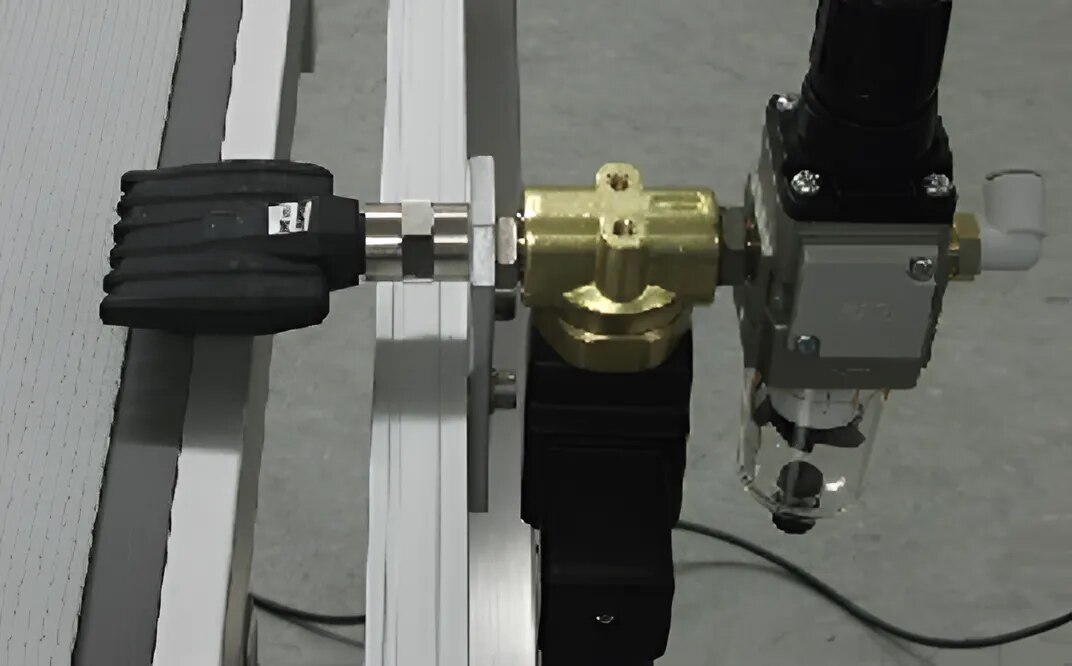
A failed product is moved sideways by a short, controlled blast, not simply pushed off the belt. After the checkweigher marks it for rejection, a solenoid valve opens and sends regulated compressed air through a nozzle.
The pulse strikes the product’s exposed surface and drives it into a defined capture zone, reject chute or bin that keeps it out of the accepted-product path.
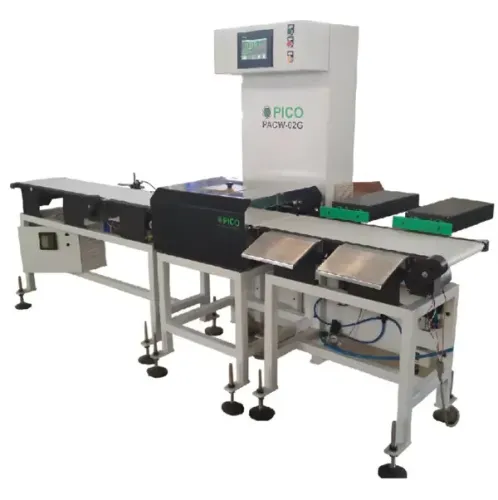
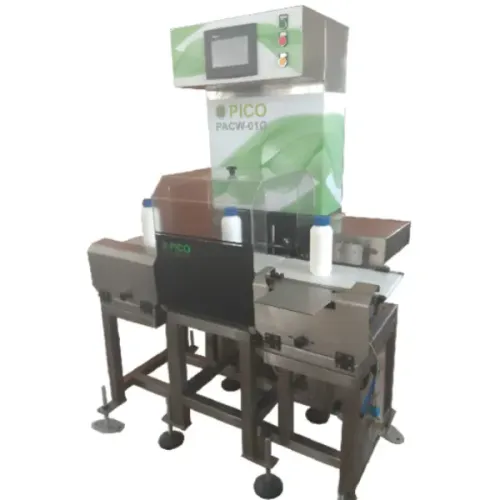
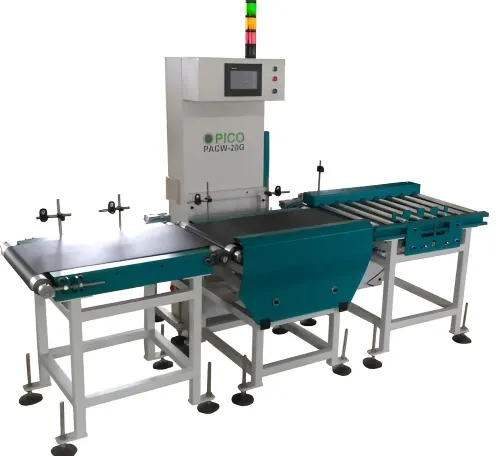
A checkweigher air jet reject system must track that specific item from the weighing belt to the nozzle. An encoder, product sensor or equivalent position-tracking system measures belt movement and product spacing; the controller then adds conveyor and valve response delays before firing.
A fixed time delay becomes inaccurate when speed, belt slip or product pitch changes.
The pulse must last long enough to clear the product’s full width and overcome belt friction, while the nozzle sits close enough to apply force without striking the next item. Containment matters: guards, a shaped chute and a reject-bin-full signal prevent rebound or overflow from returning product to the line.
Air rejection is not fail-safe; low pressure, a blocked nozzle, failed solenoid or stuck valve can leave a failed product in the accepted stream. Define whether those conditions trigger an alarm, line stop or positive mechanical reject.
Select the air supply, nozzle and firing point from line conditions
Product mass and shape set the force requirement. A heavy, compact pack needs more air impulse than a light pouch; a tall pack presents a larger target than a flat one, while a flexible or unstable pack may fold instead of moving cleanly. Test the actual product, not an empty carton or nominal weight.
- Set air pressure high enough to move the heaviest product at the lowest available line pressure. Increase nozzle diameter or pulse duration when the product needs more air volume, rather than raising pressure until packaging is damaged.
- Aim the nozzle at the product’s centre of mass, close enough for a concentrated jet but outside the product’s swept path. A wide nozzle suits broad targets; a small nozzle gives sharper control and uses less air.
- Shorten the pulse until the failed product clears the accepted-product path. Excess duration can strike the following item, especially at minimum pitch.
- Place the nozzle where the belt provides a defined capture zone and enough room for the product to enter a reject bin or contained lane. A deflection without containment is not a complete automatic product rejection conveyor.
Reject timing must follow position, not a fixed delay. Use an encoder, product sensor, or equivalent tracking to calculate travel from the weighing point to the nozzle, then add conveyor delay and valve response time. Product length and minimum spacing determine whether the pulse window fits between items.
Commission at maximum belt speed, minimum pitch, heaviest product and lowest tested air pressure. Measure pressure drop during repeated firing and confirm that a missed reject triggers the specified stop, alarm or containment response.
Prevent one blast from disturbing the wrong product
Reject reliability starts with product separation, not a larger nozzle. Set the infeed pitch so only one pack occupies the reject window; use metering, guides and a defined capture zone leading to a reject bin or contained lane. If packs touch, one pulse can move an accepted product with the failed one.
Confirm the air reject system for food processing also has filtered, dry air, condensate control and a documented purity and maintenance program when air can contact product or food-contact surfaces.
- Touching packs: stop or separate them before the reject station; do not rely on a stronger pulse.
- Skewed packs: use side guides and confirm the skewed profile still enters the capture zone.
- Unstable or tall products: reduce the exposed lever effect, support the pack, and test tipping into guards.
- Flexible or flat packs: use a wider, lower-force pulse and verify that they do not fold, slide under the jet or rebound.
- Leaking or poorly sealed packs: contain liquid or powder, inspect the seal after rejection, and prevent residue from reaching belts and guides.
Prove rejection at production speed, not with an empty conveyor. Run failed packs beside accepted packs at minimum pitch and maximum throughput, then record every miss, double reject, accepted-pack movement and product collision.
Check that each failed pack clears the accepted path, reaches containment, retains label position and seal integrity, and does not create dust, noise or a secondary hazard. Test pressure at the nozzle during repeated firing; regulator pressure alone proves nothing.
Compare air jets with pushers, diverters, flaps and dual rejection
Choose air rejection for light, stable products with a predictable exposed surface, adequate clearance and clean, dry compressed air; select a mechanical device when the product resists a short lateral impulse.
| Option | Best fit | Main limitation |
|---|---|---|
| Air jet | Small, light packs at high speed | Noise, air consumption, dust movement and packaging damage |
| Pusher | Heavy cartons, high-friction products or low-clearance lines | Requires space, guides and moving-part guarding |
| Diverter | Rigid products needing controlled lane changes | Needs clearance and can disturb adjacent products |
| Flap | Rigid, stable packs at moderate speed | Can snag flexible film or deform weak packs |
| Dual rejection | Mixed products, critical containment or missed-reject risk | Higher cost, controls complexity and maintenance |
Product weight, belt friction and centre of gravity decide whether an air pulse can move the pack far enough to clear the accepted-product path. Flexible bags, rolling containers, leaking packs and low-profile items need trials for seal integrity, label position, deformation and capture-zone performance.
Choose a pusher, swing arm, drop-belt or divert conveyor when air quality cannot meet filtration requirements, repeated firing causes pressure recovery problems, or noise and airborne powder create safety concerns. Guard every mechanical movement and contain every rejected product.
For a checkweigher rejection mechanism in Tamil Nadu, state whether the instrument serves legal-for-trade quantity control under OIML R 51-related requirements or internal quality control. An air jet is not a complete rejection system unless the bin, chute or downstream containment proves the failed product was captured.
Turn the requirement into a commissioning and purchase specification
Write the purchase specification around the worst operating case, not the nominal line speed. An air jet rejection option checkweigher in Coimbatore is not adequately defined until the builder has product, utility, hygiene and compliance data.
1. Record product length, width, height, mass range, centre of gravity, surface shape, temperature, moisture, packaging flexibility, minimum pitch, belt speed, throughput and permissible weight error.
2. State the available air pressure and flow, filtration, condensate control, air-contact purity requirement, washdown chemicals, enclosure rating and noise limit. Identify whether the air can touch food or food-contact surfaces, then require a documented filter-maintenance and verification plan.
3. Ask for the tracking method between the weighing point and nozzle: encoder feedback, product sensors or equivalent. Require the timing calculation to include belt speed, belt slip, product length, pitch, sensor delay and solenoid response time; a fixed time delay alone is not sufficient.
4. Require a signed factory or site test using the heaviest, lightest, tallest, most flexible and least stable products at minimum pitch, maximum speed and low available air pressure. Count correct rejects, false rejects, damaged packs and missed rejects, then specify the response to a missed reject, such as line stop, alarm and product quarantine.
5. Confirm whether the instrument serves statutory quantity control or internal quality control. For legal-for-trade use, identify OIML R 51 requirements and the applicable Indian metrology verification, marking and test procedures before approving the weighing configuration.
Pico Automation should state these acceptance limits in the quotation and commissioning record, not leave them as verbal assurances. If heavy cartons or rolling packs fail the air test, specify a pusher, diverter or dual-rejection arrangement instead.
Related product
 | Checkweighers Optional Features The air jet mechanism operates in milliseconds to maintain the continuous flow of high-speed lines: Defect Detection: As an item travels down the... View product → |
Frequently asked questions
How does a compressed-air pulse move one failed product?
The checkweigher identifies an out-of-tolerance product, then opens a solenoid valve for a timed pulse through a nozzle. The pulse applies lateral force and moves the product into a reject lane or bin.
How do you select the air supply, nozzle and firing point?
Base the selection on product mass, belt speed, product spacing, package shape, available pressure and the distance from the weighing point to the nozzle. Test the pulse duration and nozzle position at the fastest operating speed.
How do you prevent one blast from disturbing the wrong product?
Use accurate product detection, calculate the travel time from the weigh point to the nozzle, and set a pulse window that ends before the next product reaches the firing point. Confirm the rejected product with a downstream sensor.
When should you choose an air jet instead of a pusher, diverter or flap?
Choose an air jet for lightweight products that need fast, contact-free removal and have sufficient side clearance. Compare pushers, diverters and flaps when products are heavy, unstable, tightly spaced or difficult to control with air.
Keywords