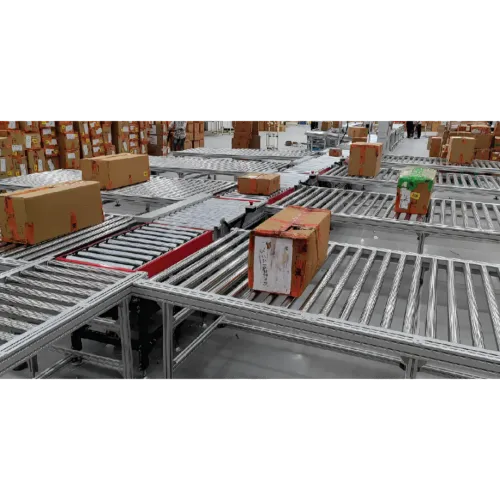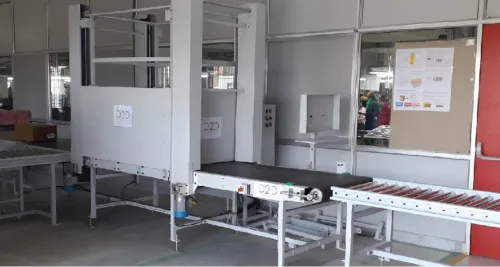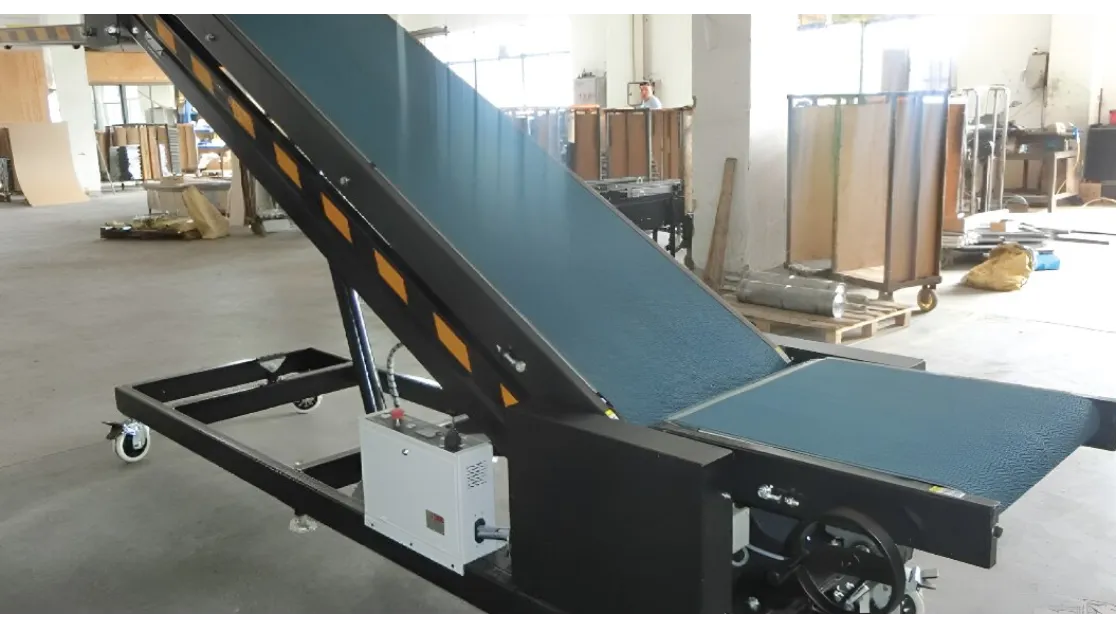
Loading and unloading loose cartons from trucks is physically demanding and often inefficient. Workers may repeatedly carry packages between a fixed dock conveyor and the far end of a vehicle, increasing travel time as the loading process progresses.
A Telescopic Truck Loading Conveyor extends directly into the vehicle, shortening this distance and allowing the discharge or receiving point to move with the work.
Where the Time Savings Come From
Without a telescopic conveyor, employees may form a chain, walk cartons through the vehicle, or reposition temporary equipment. These methods can involve substantial non-productive movement.
An extendable conveyor enables cartons to travel closer to their final position. The operator can retract or extend the unit as the truck fills or empties. Depending on the configuration, height adjustment may further improve alignment with different vehicle beds.
The resulting time reduction depends on carton rate, vehicle size, dock arrangement, and labour method.
Calculate the Current Loading Cost
A practical ROI study begins with real operating data. Record:
- Trucks handled per shift
- Average cartons per vehicle
- Employees assigned to loading
- Time required for each truck
- Labour cost per hour
- Overtime caused by dispatch delays
- Product-damage incidents
- Waiting charges or detention costs
- Seasonal peak volumes
Avoid basing the calculation only on the fastest or slowest day. Several weeks of representative data provide a more credible baseline.
Include Throughput and Dock Utilisation
Faster loading may allow a dock to handle more vehicles within the same shift. This can postpone the need for additional dock infrastructure and reduce queues during dispatch peaks.
For e-commerce, FMCG, logistics, and packaging operations, departure cut-off times are especially important. A delay at loading can affect route schedules even when picking and packing were completed on time.
The value of improved dock availability should therefore be included alongside direct labour savings.
Account for Ergonomics and Product Handling
A telescopic conveyor cannot eliminate every lifting task, but it can reduce the distance employees carry cartons. Better positioning may also limit unnecessary twisting, walking, and repeated hand-to-hand transfers.
Damage reduction can provide another financial benefit. Fewer manual transfers generally mean fewer opportunities for packages to be dropped or crushed. Actual savings should be estimated from the facility’s damage records rather than assumed percentages.
Consider Ownership Costs
ROI calculations should also include the full cost of ownership:
- Equipment purchase and installation
- Electrical and civil preparation
- Preventive maintenance
- Replacement belts, rollers, and sensors
- Operator and maintenance training
- Energy consumption
- Downtime provisions
- Safety inspection and guarding
If the conveyor will operate across multiple shifts, durability and service support may matter more than a small difference in initial price.
Confirm Site Suitability
The dock needs adequate space for the conveyor’s fixed and extended lengths. Vehicle dimensions, dock leveller movement, door clearance, traffic routes, and storage space must be examined.
Powered extension, belt direction, controls, lighting, operator platform needs, and emergency-stop locations should be selected around the actual loading method.
Pico Automation can evaluate truck movement and dispatch processes at facilities in Coimbatore and elsewhere in Tamil Nadu before recommending a configuration.
Use a Simple Payback Model
Annual benefit can be estimated by combining measurable labour savings, additional dock capacity, lower overtime, reduced vehicle waiting, and documented damage reduction. Subtract estimated annual operating and maintenance costs, then compare the net benefit with the installed investment.
Payback is only one measure. Capacity, safety, dispatch reliability, and future growth may also justify the project. A strong business case uses conservative data and tests the proposed conveyor against representative vehicles and package sizes.
Keywords