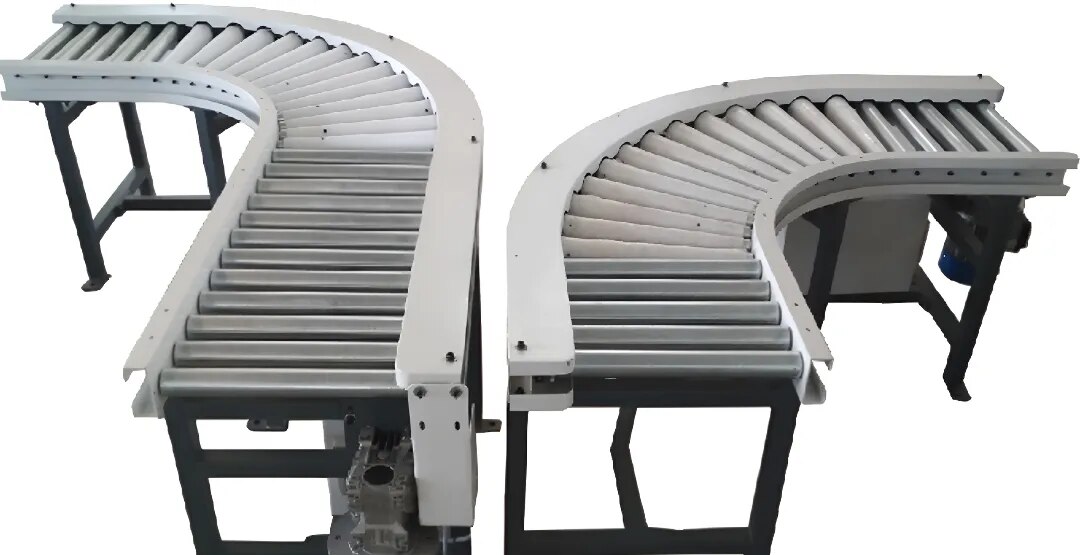
Powered Roller Conveyors
Description
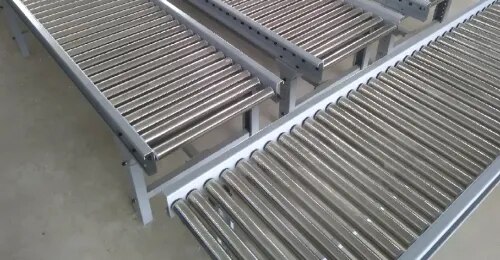
The conveyor consists of a series of rollers mounted in a frame, but underneath or alongside those rollers lies a drive mechanism. Power is transmitted from an electric motor to the rollers using one of several methods:
Belt-Over-Roller: A flat motorized belt runs directly underneath the rollers, spinning them via friction.
Chain-Driven Live Roller (CDLR): Each roller is connected to the next by a loop of heavy-duty steel chain. This provides massive torque and is ideal for heavy pallets or drums.
Line-Shaft Conveyor: A long rotating shaft runs underneath the frame, and individual elastomeric O-rings connect the shaft to each roller. If an item is blocked, the rings slip, preventing damage to the motor.
Motorized Roller (MDR): The latest technology, where every few rollers contain their own internal, 24V DC brushless motor inside the tube itself.
Key Features & Advantages
Controlled Automation: Because the rollers are motorized, you can precisely control the speed, start/stop times, and spacing of items on the line.
Zero-Pressure Accumulation (ZPA): Advanced powered systems (especially MDRs) can detect when a package has stopped ahead. The conveyor will automatically turn off specific sections (zones) of rollers so packages queue up neatly without colliding or crushing each other.
Bidirectional Travel: With the flip of a switch, the electric motor can reverse direction, allowing goods to travel both forward and backward on the same line.
Heavy Weight Capabilities: Systems like CDLR can move immense loads—such as raw steel plates, automotive chassis, or 2,000-pound pallets—with ease.