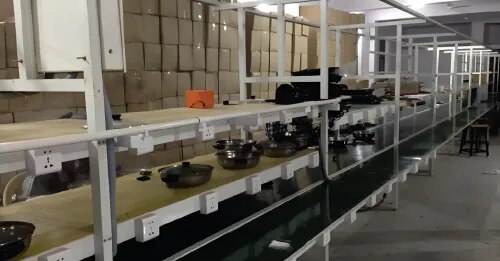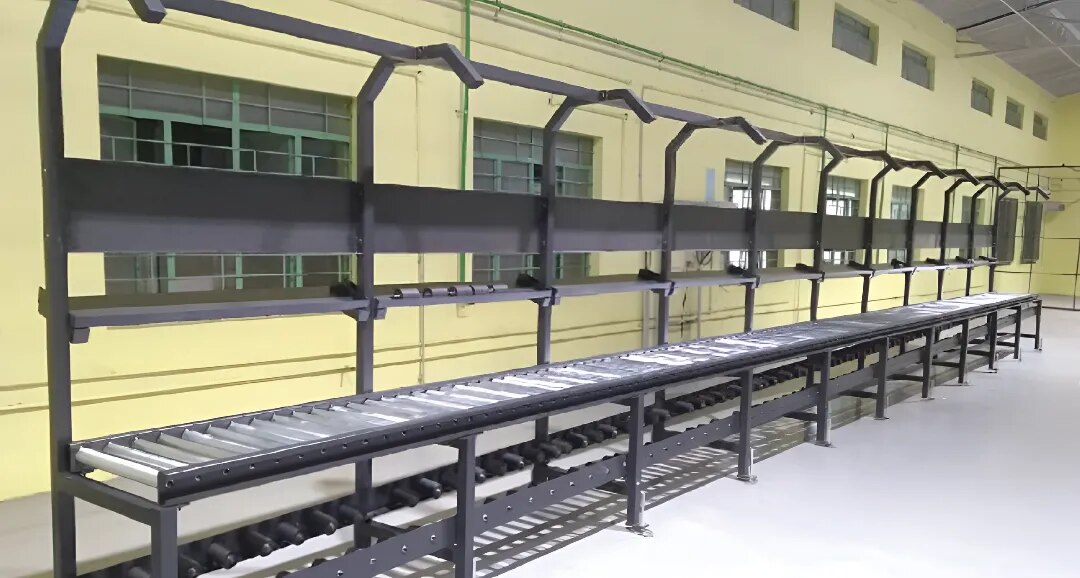
Assembly Line Roller Conveyors
Description
Assembly line roller conveyors can be either unpowered (gravity-fed) or powered (motor-driven).
Product Placement: A rigid item, carrier, or tote is placed onto the rollers. The item must span at least three rollers at all times to maintain stability and smooth movement.
Transportation: In a powered system, an electric motor spins the rollers via a belt or chain underneath, driving the product forward. In a manual or gravity system, the product is pushed by a worker or slides down a slight incline.
Zoned Accumulation: A critical feature for assembly lines is Zero Pressure Accumulation (ZPA). Sensor-controlled zones allow products to stop right behind each other without colliding, giving a worker at a downstream station time to finish their task without stopping the whole conveyor line.
Key Types of Roller Conveyors
Depending on the assembly task, different drive mechanisms are used:
1. Line-Shaft Roller Conveyors
A single long shaft runs underneath the conveyor frame, connected to each individual roller by a small rubber O-ring.
The Benefit: It is highly economical and allows for easy accumulation. If a worker holds a product still, the O-ring simply slips, stopping the roller without destroying the motor.
2. Motorized Roller Conveyors (MDR)
Instead of one large central motor, these modern systems use “smart rollers” that have small, internal 24V DC brushless motors built directly inside every few rollers.
The Benefit: They run only when a product is detected in that specific zone, making them incredibly energy-efficient, quiet, and highly customizable for automated robotic stations.
3. Chain-Driven Live Roller (CDLR)
Heavy-duty rollers are linked to one another and a main drive motor using standard industrial chains and sprockets.
The Benefit: Built for rugged environments and massive loads, such as engine blocks, casting molds, or fully assembled vehicles.
Key Components
Rollers: Cylindrical tubes made of galvanized steel, aluminum, or heavy-duty plastic, containing internal ball bearings for smooth spinning.
Frame & Side Guides: Structural steel rails that hold the rollers in place and prevent products from drifting off the edges.
Sensors (Photo-Eyes): Placed at regular intervals to detect the presence of an item, acting as the “eyes” of the automation system to start or stop specific zones.
Pneumatic Stops/Lifters: Devices built into the line that pop up physically to halt a product at an exact workstation, or lift it slightly so a robot can perform a precise task like welding or drilling.
Major Advantages in Assembly
1. Ideal Work Surface
Because the rollers are rigid steel, workers can safely assemble parts, torque bolts, and stamp components directly on top of the product while it rests on the line.
2. Precise Position & Control
Paired with automation sensors and stoppers, roller conveyors can align a product within millimeters of a specific target. This is a strict requirement for automated robotic assembly cells.
3. Buffering and Staging
If Station A finishes a task faster than Station B, the roller conveyor acts as a buffer zone, storing completed parts in line without creating pressure or crushing items against each other.