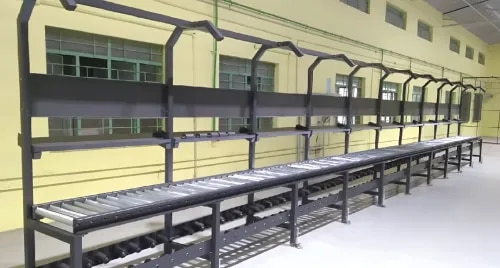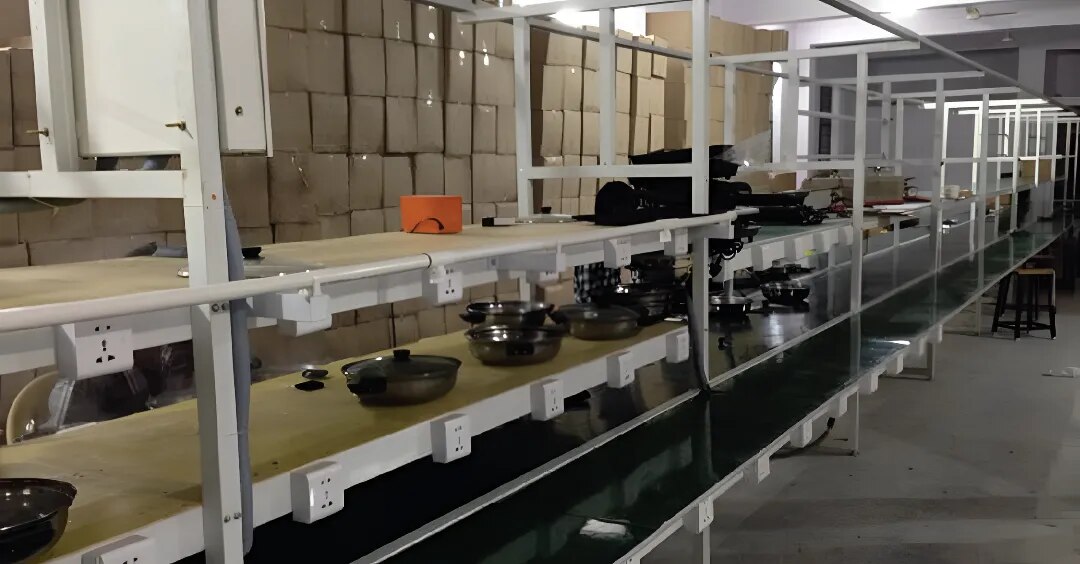
Assembly Line Belt Conveyors
Description
The mechanics of a belt conveyor are straightforward but highly efficient:
The Loop: A continuous belt is looped around two or more pulleys (drums).
The Drive: A motorized drive pulley pulls the belt forward, while a tail pulley provides tension at the opposite end.
The Bed: Underneath the moving belt sits a solid metal plate (called a slider bed) or a series of support rollers. This keeps the belt perfectly flat and stable under the weight of the products.
The Assembly Flow: Workers or robotic arms sit stationed alongside the belt. As items glide past at a controlled, continuous speed, operators perform specific tasks (assembling, soldering, inspecting, or packaging) before the item moves to the next station.
Key Types of Belts Used in Assembly
The choice of belt material depends entirely on the industry and the specific assembly environment:
Fabric/PVC Belts: The standard choice for general assembly. They are cost-effective, smooth, and work perfectly for lightweight electronics, toys, and packaged goods.
Modular Plastic Belts: Made of interlocking plastic segments (like LEGO bricks). These are incredibly durable, easy to clean, and allow air or liquid to drain through. If one section breaks, you only replace that small module rather than the entire belt.
Anti-Static (ESD) Belting: Crucial for electronics and semiconductor assembly. These belts are treated to dissipate static electricity, preventing costly shock damage to sensitive microchips and circuit boards.
Cleated Belts: Feature raised vertical ridges (cleats) across the belt. These are used when an assembly line needs to move parts up or down steep inclines without them sliding backward.
Key Components
Conveyor Belt: The moving surface carrying the load.
Slider Bed: A smooth, low-friction steel plate that supports the belt, ensuring a completely flat work surface.
Variable Speed Drive (VFD): A motor controller that allows managers to precisely speed up or slow down the line to match the target production rate (takt time) of the workers.
Side Guides/Rails: Adjustable rails along the edges that keep products perfectly aligned and prevent them from falling off.
Major Advantages in Assembly
1. Ultra-Smooth and Stable Transport
Because the surface is completely continuous, components remain perfectly stable. This is vital for tasks like automated precise gluing, robotic picking, or transporting loose parts that haven't been fastened down yet.
2. Handles Small and Delicate Parts
Small screws, loose wires, and miniature components can easily get jammed in a roller conveyor. A belt conveyor safely carries even the tiniest micro-components without risk of loss or mechanical jams.
3. Highly Adaptable Environment
Belt conveyors can be seamlessly integrated with overhead lighting, tool rails, parts bins, and ergonomic workstations, transforming a basic moving belt into a fully optimized manual or automated assembly cell.