
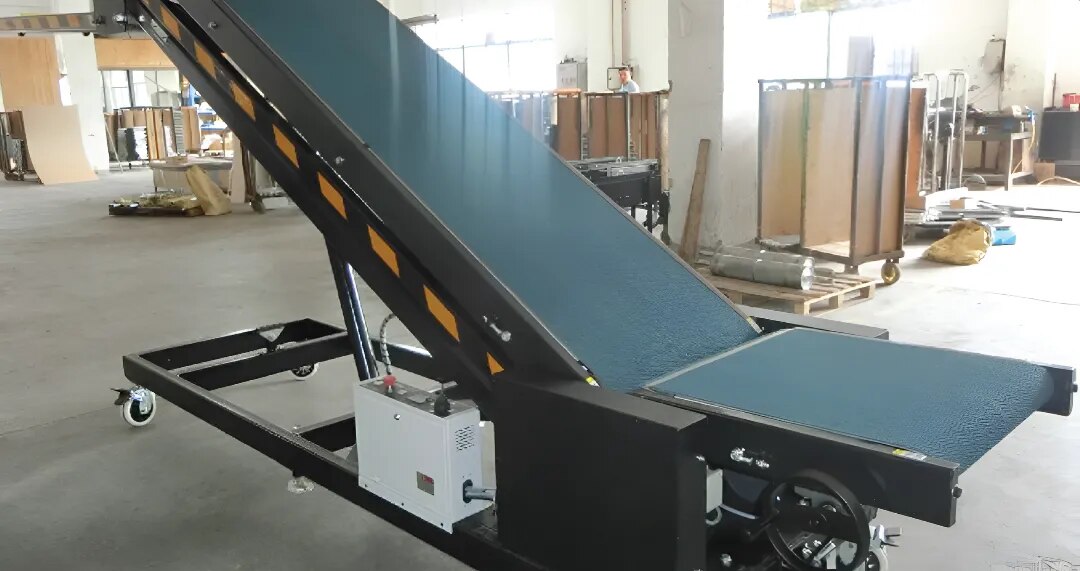
Truck Loading Conveyors
Description
The core concept relies on high mobility and reach. A standard operation follows this workflow:
Positioning: A truck backs up to the loading dock.
Extension: An operator uses an electronic joystick or button panel to extend the conveyor forward. The conveyor sections slide out from within one another—much like a telescope—moving deep into the truck bed.
Continuous Loading: Packages feed from the warehouse main line onto the truck loading conveyor, traveling straight to the worker inside the truck who stacks them from floor to ceiling.
Retraction: As the truck fills up, the operator progressively retracts the conveyor, keeping the drop-off point perfectly positioned right next to the stacking wall.
Key Configurations & Types Depending on a facility's layout and budget, truck loading conveyors generally fall into three categories:1. Telescopic Belt Conveyors The gold standard for high-volume distribution centers. These are heavy-duty, motorized structures fixed to the dock floor. They feature multiple nested steel stages that extend up to 50+ feet ($15+$ meters) using a continuous internal belt.2. Flexible Expandable Conveyors A more cost-effective, versatile option. These are portable, non-fixed units set on heavy casters. They utilize a “lazy-susan” accordion frame with skate wheels or rollers. Workers can manually pull, curve, and stretch them into the back of a truck, and then compress them into a fraction of their size to store out of the way when finished.
3. Cantilevered / Boom Conveyors
Rigid, heavy-duty overhead structures that can pivot horizontally or adjust vertically (boom up/down) to match the exact height of different truck beds or containers.
Major Advantages
1. Massive Drop in Ergonomic Strain
Manually walking heavy parcels from a dock door to the front of a trailer is one of the leading causes of workplace injuries in logistics. Bringing the conveyor directly to the worker eliminates lifting-and-carrying walks, minimizing back strains and repetitive motion injuries.
2. Rapid Truck Turnaround Times
By streamlining the loading process into a continuous stream, facilities can cut truck loading and unloading times by up to 50%. This maximizes dock door utilization and prevents logistical bottlenecks.
3. Optimized Cube Utilization
Because workers aren't exhausted from walking back and forth, they can focus their energy on neatly and tightly packing the trailer (known as “floor loading”). This ensures minimal wasted space and lower freight costs.