
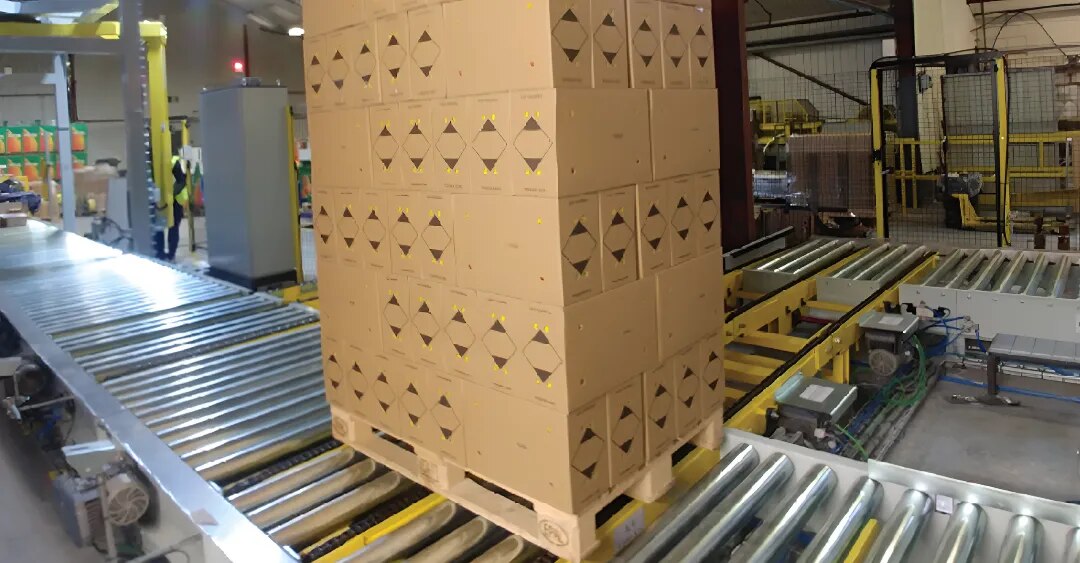
Pallet Transfer Conveyors
Description
The defining feature of a pallet transfer system is its ability to route heavy pallets through complex networks (turning $90^circ$, merging lines, or shifting lanes) without rotating the pallet itself. This is achieved using two primary components:
1. Main Line Conveyors Pallets travel down straight paths using one of two methods:
Chain Conveyors: Typically utilize two or three parallel strands of heavy-duty roller chains. They are ideal for pallets with bottom boards running perpendicular to the direction of travel.
Roller Conveyors: A series of motorized steel rollers. These are best when the pallet's bottom boards run parallel to the conveyor's movement.
2. The Transfer Unit (The “Right-Angle” Shift)
When a pallet needs to switch to a intersecting line, a 90-degree transfer unit is used.
How it works: A chain conveyor segment is nested between the rollers of a roller conveyor (or vice versa).
The motion: When a pallet arrives, a pneumatic or electric lift raises the nested chains slightly above the rollers. The chains turn on, pulling the pallet off at a perfect right angle onto the new line. The mechanism then lowers back down, ready for the next pallet.
Key Components:
Heavy-Duty Modules: Frames are constructed from thick, structural steel to withstand the immense impact of forklifts loading and unloading pallets.
Pallet Dispensers/Stackers: Automated machinery integrated into the line that automatically feeds empty pallets onto the conveyor or stacks them up for storage.
Turntables: For instances where a pallet does need to be rotated (e.g., changing its orientation for a labeling machine or an operator station), a powered rotating platform is integrated into the grid.
Lifters and Elevators: Vertical reciprocating conveyors (VRCs) that lift entire pallets to different mezzanine levels or overhead tracks.
Major Advantages
1. Massive Weight Capacity
Standard conveyor belts would tear or burn out under industrial weights. Pallet conveyors routinely handle standard loads of 1,000 to 3,000 lbs (450 to 1,350 kg), and custom lines can handle much more.
2. Reduced Forklift Traffic
By automating the movement of pallets from the production floor straight to the warehouse or shipping dock, facilities drastically reduce the need for forklifts. This lowers labor costs, minimizes floor traffic chaos, and significantly increases workplace safety.
3. Precision Positioning
Advanced pallet lines use proximity sensors and variable frequency drives (VFDs) to stop a 2,000-pound pallet within millimeters of a target. This precision is required for robotic palletizing, stretch-wrapping, and Automated Storage and Retrieval Systems (AS/RS).