
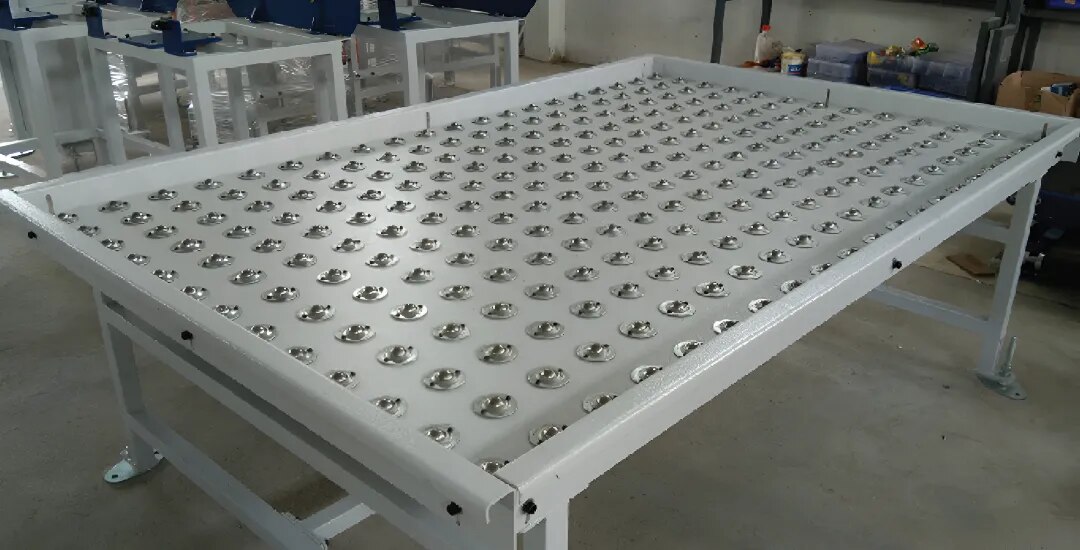
Ball Transfer Tables
Description
A Ball Transfer Table is a material handling surface embedded with an array of omnidirectional, load-bearing spherical balls (known as ball transfer units).Unlike traditional roller conveyors that only move items forward or backward in a single straight line, a ball transfer table allows items to be rotated 360- Degree and shifted smoothly in any direction with minimal effort.
Key Components
Ball Transfer Units: Individual housings containing a large, exposed ball sitting on a bed of smaller, internal ball bearings. This design minimizes friction, allowing heavy loads to glide easily.
Table Frame/Plate: A rigid steel or aluminum plate that holds the units in a grid or staggered pattern.
Support Structure: Heavy-duty legs or frames, often height-adjustable, to integrate seamlessly with existing conveyor lines.
Primary Benefits
Multi-Directional Movement: Enables seamless right-angle transfers, orientation changes, and manual sorting without needing complex mechanical diverters.
Ergonomic Design: Drastically reduces the physical exertion required by operators to push, pull, or spin heavy objects like cargo, metal sheets, or tooling dies.
Space Efficiency: Ideal for tight spaces where a curved conveyor line won't fit, acting as a compact junction point between different production lines.
Considerations for Selection
When designing or purchasing a ball transfer table, several factors must be considered:
Weight Capacity: The total weight of the product divided by the number of balls supporting it at any given time (ideally, a minimum of 3 balls should touch the product surface at all times).
Surface of the Load: The bottom of the object being moved must be firm, flat, and smooth (like steel, rigid plastic, or smooth wood). Soft or flexible bottoms (like burlap sacks or corrugated cardboard boxes with heavy sagging) can get stuck between the balls.
Environment: For wet or outdoor environments, stainless steel or nylon balls are preferred to prevent rusting.