90 degree Belt Conveyors
Description
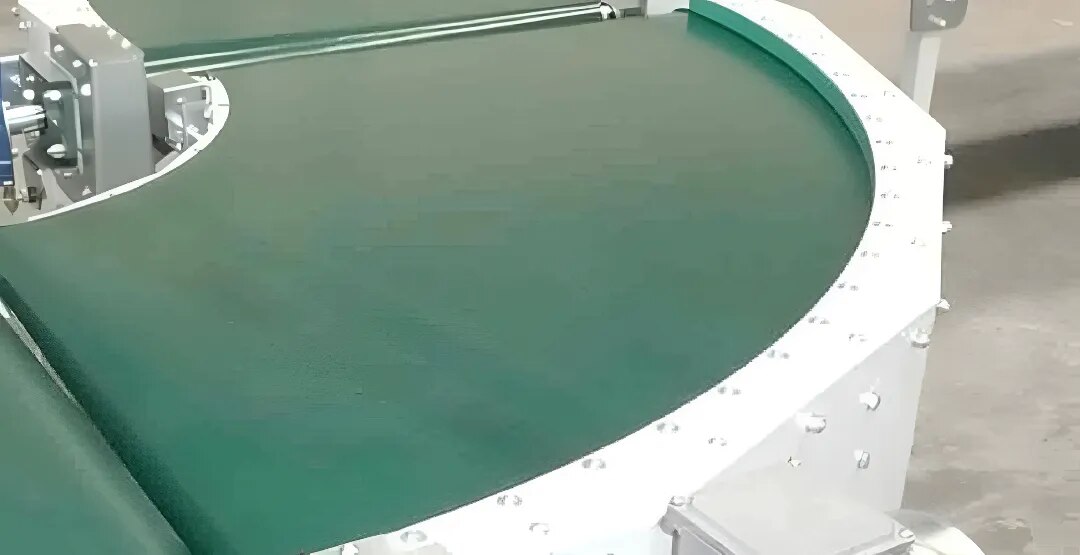
Because the outside edge of a 90-degree turn is longer than the inside edge, a standard straight conveyor belt cannot be bent into a curve; it would bunch up on the inside and stretch or snap on the outside.
To solve this, a 90-degree conveyor uses a conical (tapered) pulley design combined with a pre-shaped, curved belt. The drive pulleys are wider on the outside diameter and narrower on the inside. This allows the outside of the belt to travel faster than the inside, ensuring that products move uniformly around the bend without slipping or spinning.
Key Features & Advantages
Maintains Product Orientation: If a box enters the curve facing forward, it exits the curve facing forward. This is critical for automated lines featuring barcode scanners, label applicators, or vision inspection systems that require products to be in a precise position.
Smooth, Gentle Transfers: Because the transition is seamless, it prevents fragile items (such as glassware, delicate electronics, or unpackaged food items) from jarring, tipping over, or bumping into each other.
Positive Belt Tracking: To prevent the immense centrifugal force from pulling the belt toward the inside of the turn, the belt is physically locked into the frame. This is usually achieved using sealed bearings, guide rollers, or a continuous chain/bead guide sewn directly into the outside edge of the belt.
Space Optimization: It allows factories and warehouses to maximize their floor space by routing production lines around structural pillars, walls, or into tight “U-shape” and “S-shape” room configurations.
Common Applications
90-degree belt conveyors are vital junction points used to connect separate legs of an automation system:
Airport Baggage Handling: Safely navigating checked luggage and bulky suitcases through tight terminal walls from the check-in desk to the sorting area.
E-commerce & Distribution Hubs: Routing cardboard shipping boxes out of a main sorting vein into a specific 90
∘
shipping lane or dock door.
Food & Beverage Production: Moving baked goods, bottles, or canned items through processing, filling, and packaging areas without causing them to spill or crash.
Manufacturing Assembly Lines: Guiding components around a workspace to form continuous loops, ensuring a constant workflow for assembly workers.